
Research Achievements and Highlights
Flexible perovskite solar cells (PSCs) are regarded as a key development direction for next-generation energy technology due to their lightweight nature, high flexibility, and low-cost fabrication potential. However, ensuring operational stability and photovoltaic efficiency without increasing material costs remains a major challenge.
The technical bottleneck lies in the transparent electrode used in traditional high-performance flexible perovskite cells—indium tin oxide (ITO). ITO is inherently brittle and cannot withstand repeated bending, folding, or twisting mechanical stresses, leading to unstable device power output. Additionally, existing research has shown that ITO may undergo degradation in perovskite devices, affecting long-term reliability.
This research, completed through collaboration among researchers from multiple institutions including Wei Zhang and S. Ravi P. Silva from the University of Surrey (UK), Academician Hui-Ming Cheng from the Chinese Academy of Sciences, Tongle Bu from Wuhan University of Technology, Sai Bai from the University of Electronic Science and Technology of China, and Samuel D. Stranks from the University of Cambridge, was published in the journal Joule.
To overcome ITO’s brittleness and cost issues, the research team employed single-walled carbon nanotubes (SWCNTs) as an alternative electrode. SWCNT films possess excellent mechanical robustness, while their hydrophobic characteristics help suppress moisture intrusion, thereby enhancing device stability.
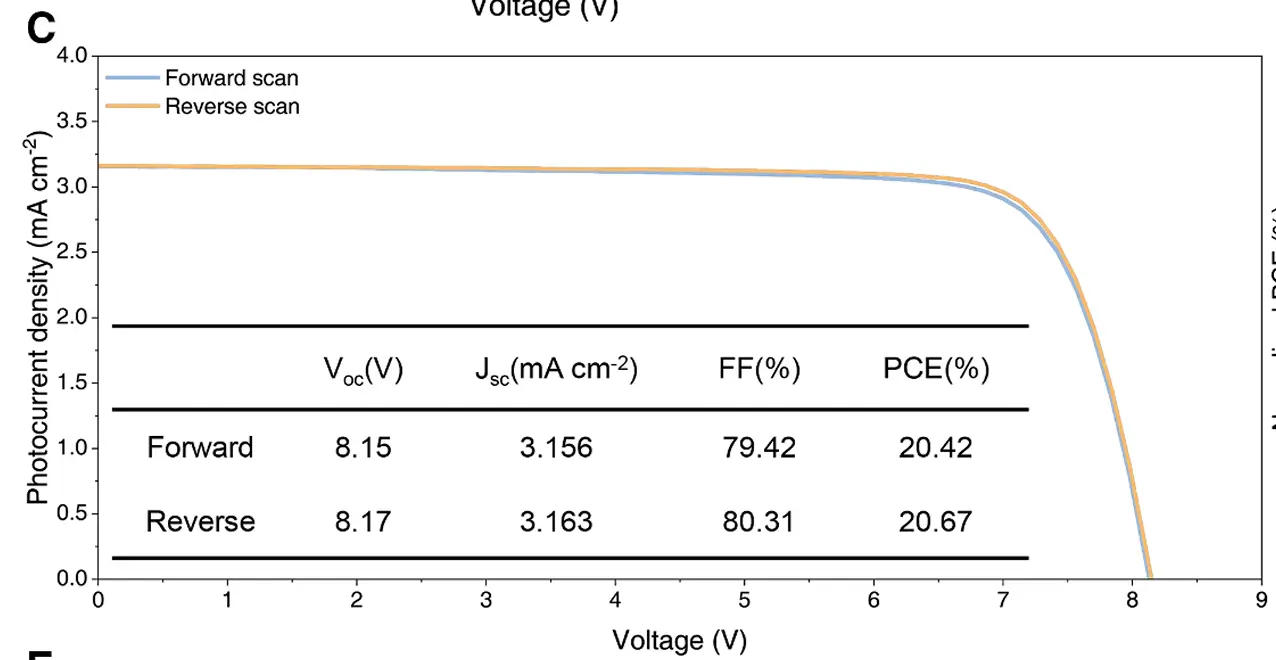
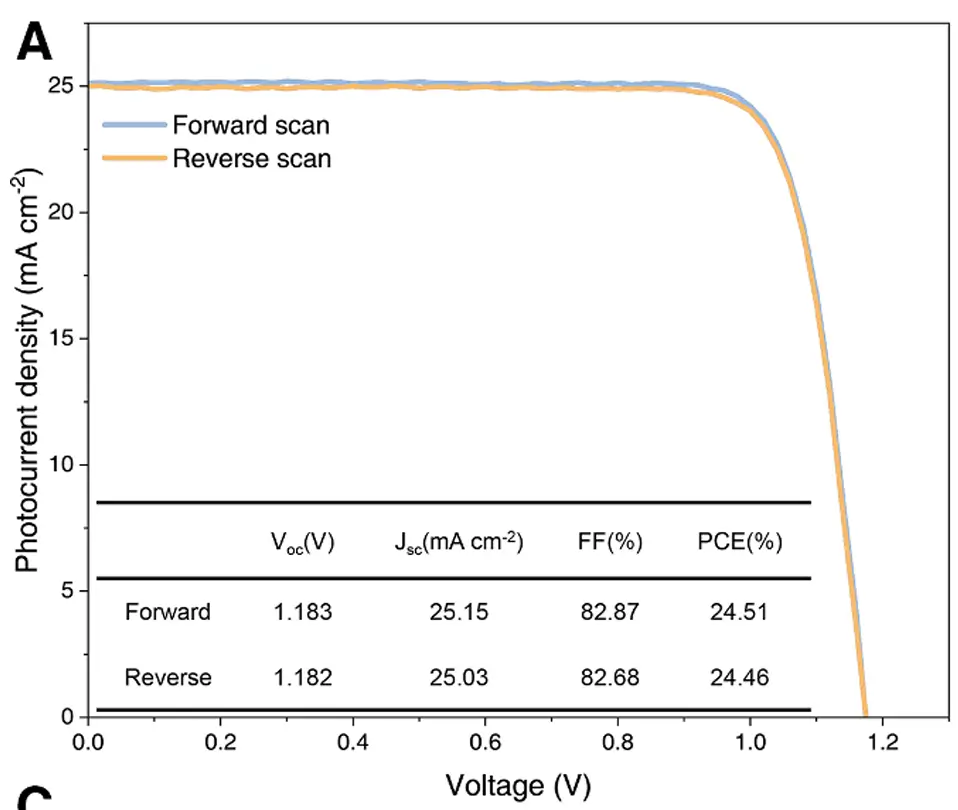
The core approach involves treating SWCNT films with sulfuric acid (H2SO4), which significantly reduces the electrode’s sheet resistance while maintaining high optical transmittance. The H2SO4-treated SWCNT electrode enabled rigid perovskite solar cells (PSCs) to achieve a power conversion efficiency (PCE) of 24.5%, while flexible modules (f-PSMs) with an active area of 11.5 cm² achieved PCE exceeding 20%. (Figure 2C)
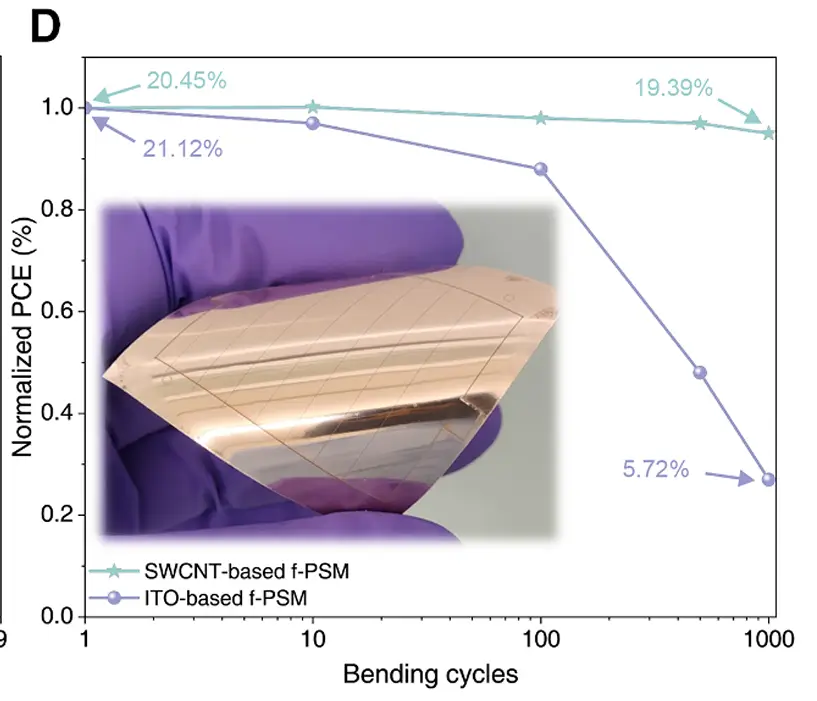
These SWCNT-based f-PSMs exhibited only approximately 5% PCE degradation after 1000 bending cycles. (Figure 2D)
Quasi-Fermi Level Splitting (QFLS) and Photoelectrical Characterization
QFLS Characterization Principles and Measurements
The research team postulated that H2SO4 treatment enhances quasi-Fermi level splitting (ΔE), attributed to the introduction of electron-withdrawing SO42- functional groups on the SWCNT surface. This not only promotes p-type doping but also creates a negatively charged surface that passivates positively charged interfacial defects (such as Pb2+ and halide vacancies). QFLS values are calculated from photoluminescence (PL) spectral data.
QFLS Data and Analysis
The research quantified ΔE values for different stack structures, directly reflecting the suppression of non-radiative recombination by various interface treatments (Figure 4A):
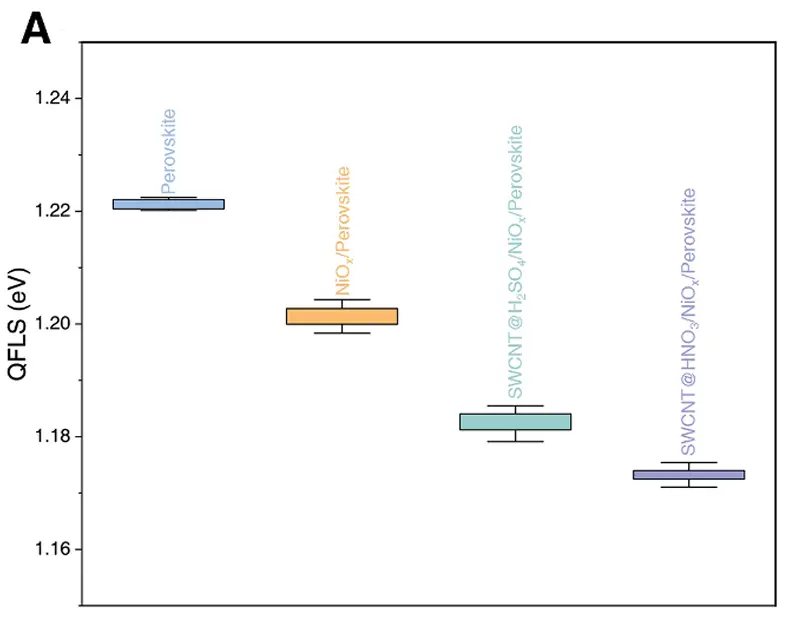
- Pure perovskite absorber layer: ΔE ≈ 1.221 eV.
- NiOx/perovskite stack: ΔE ≈ 1.202 eV.
- SWCNT@H2SO4/NiOx/perovskite stack: ΔE ≈ 1.183 eV.
- SWCNT@HNO3/NiOx/perovskite stack: ΔE ≈ 1.172 eV.
Comparing the two acid treatments, the H2SO4-treated structure’s ΔE (1.183 eV) is slightly higher than the HNO3-treated structure (1.172 eV). This difference indicates that sulfuric acid treatment more effectively reduces interfacial non-radiative recombination losses, demonstrating that H2SO4 provides superior interfacial passivation compared to HNO3.

Hyperspectral PL Mapping
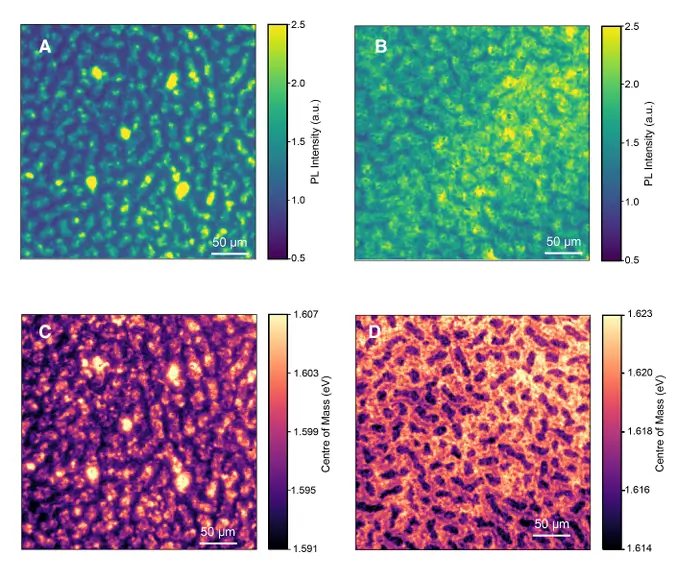
To evaluate the uniformity of internal optoelectronic properties within devices, the research team performed wide-field hyperspectral PL imaging measurements. Results showed that SWCNT@H2SO4-based devices exhibited more uniform PL emission and higher average PL intensity.
Further validation was achieved through analysis of the spectral center of mass (COM) (Figures 3C and 3D). The SWCNT@H2SO4 device’s COM distribution range was narrow at only 9 meV; in comparison, the SWCNT@HNO3 device’s COM distribution was broader at 16 meV. These results indicate that the SWCNT@H2SO4 structure produces perovskite films with superior uniformity, contributing to improved device fill factor (FF).
Carrier Dynamics Characterization
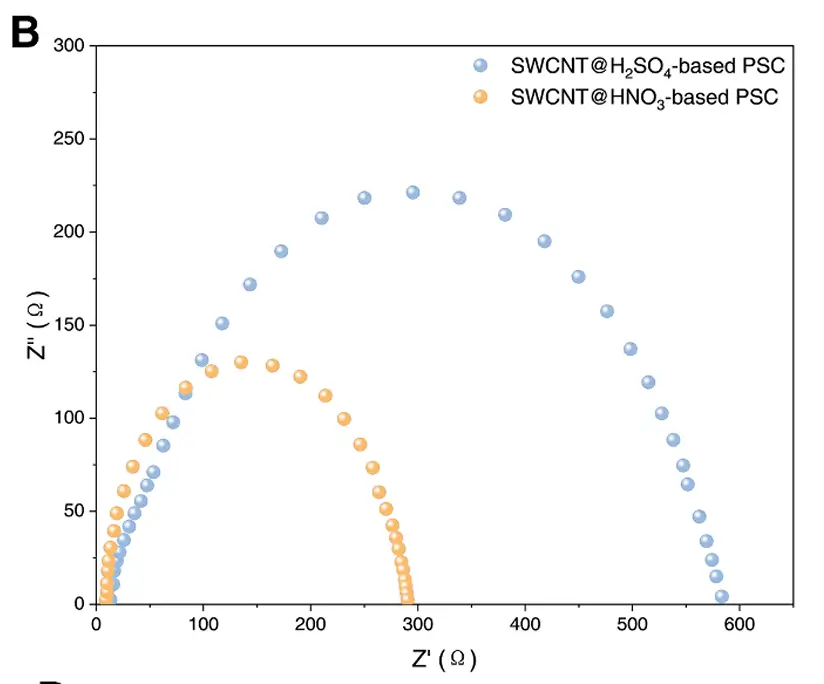
Electrochemical impedance spectroscopy (EIS) measurements revealed that SWCNT@H2SO4-based devices exhibited reduced total series resistance (Rs) to 17.6 Ω and increased recombination resistance (Rt) to 550 Ω, outperforming HNO3-treated structures (Rs = 56.2 Ω, Rt = 243 Ω). The reduced non-radiative recombination losses revealed by QFLS measurements (i.e., higher ΔE) align with the improved resistance parameters observed in EIS measurements, thus establishing a connection between macroscopic electrical performance improvements and microscopic carrier dynamics. (Figure 4B)
J-V Curve Characterization
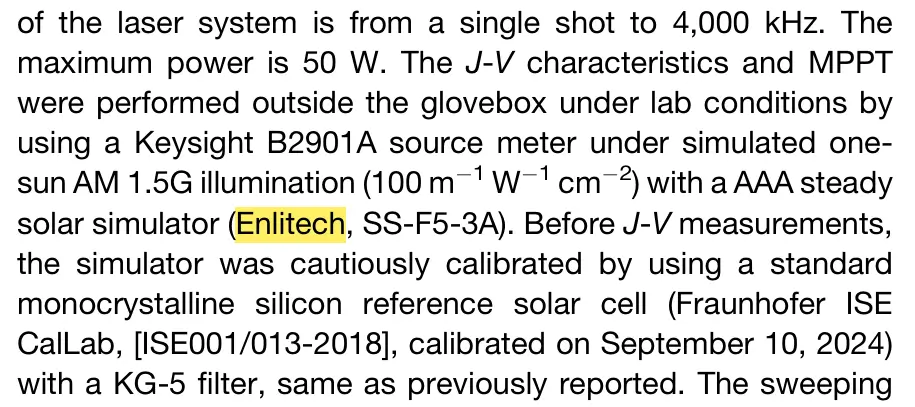
For device performance evaluation, J-V characteristics and maximum power point tracking (MPPT) measurements were conducted under standard test conditions using a Keysight B2901A source meter coupled with an Enlitech SS-F5-3A AAA-grade steady-state solar simulator (SS-X). This simulator is used to simulate AM 1.5G illumination conditions and has been calibrated with a standard silicon-based reference cell.
J-V curve results showed that the champion efficiency of rigid SWCNT-based PSCs reached 24.5% (Figure 1A).
For flexible modules (f-PSMs) with an active area of 11.5 cm², PCE exceeded 20% (Figure 2C). MPPT performance evaluation further confirmed the superiority of SWCNT electrodes: after MPPT testing, SWCNT-based PSCs retained 96% of their initial efficiency. In contrast, ITO-based devices under identical conditions retained only 57% PCE. These photoelectrical performance data, particularly the MPPT results, demonstrate that replacing ITO with SWCNT effectively enhances long-term operational stability of devices.
Conclusions and Research Outcomes
This research successfully integrated H2SO4-treated SWCNT networks into flexible perovskite solar modules, addressing the inherent deficiencies of traditional ITO electrodes in terms of mechanical durability and cost. Sulfuric acid treatment not only enhanced SWCNT conductivity but also reacted with the NiOx hole transport layer to form a dense NiSO4-NiOx composite layer.
QFLS analysis provided microscopic mechanistic evidence for this research. Through ΔE measurements and hyperspectral PL imaging, the research team confirmed that H2SO4 treatment effectively suppresses non-radiative recombination through surface defect passivation. This optimization directly translated to improvements in device electrical performance, including reduced series resistance and enhanced recombination resistance.
The research demonstrated the stability of SWCNT-based flexible modules under mechanical stress, high temperatures, and continuous illumination, maintaining over 95% of initial PCE under various external stresses. These findings provide a viable technological route for developing low-cost, scalable, and highly durable flexible photovoltaic technology, holding positive significance for accelerating the commercialization of flexible optoelectronic technologies.
Original Publication Information
Article Title: Integrating SWCNT to bridge the stability divide in scalable and manufacturable flexible perovskite solar modules
Journal: Joule
Publication Date: December 9, 2025
DOI: https://doi.org/10.1016/j.joule.2025.102225


