
Research Achievements and Highlights
Published in Advanced Functional Materials, this research led by Dr. Yihui Wu and Professor Qiang Peng’s team from the School of Chemical Engineering at Sichuan University addresses critical challenges in inverted perovskite solar cells. The study focuses on severe non-radiative recombination and poor physical contact at the perovskite/C60 electron transport layer interface. While current high-efficiency devices commonly employ thermal evaporation to deposit C60, weak van der Waals interactions between C60 and perovskite, combined with C60‘s tendency to form island-like aggregations or localized voids on rough surfaces, increase charge transport resistance and limit open-circuit voltage improvements.
To overcome these bottlenecks, the research team introduced 4-tert-butylcalix[4]arene (4tBu-CA) as an interfacial modification layer. Leveraging the high structural compatibility between 4tBu-CA’s approximately 7.5 Å cavity and C60 molecules, they achieved directional assembly based on cavity confinement effects. This strategy not only stabilized C60 deposition, but the hydroxyl groups on the lower rim of the calixarene also chelated uncoordinated Pb2+ on the perovskite surface and produced coupling effects with the interfacial molecule PDAI2 (Fig. 2).

Experiments confirmed that this supramolecular template effectively reduced non-radiative voltage losses, improving small-area device efficiency from 25.41% to 26.68%, while demonstrating excellent scalability for large-area module applications (Fig. 4b, 4h).

Research Team
This research was conducted by Dr. Yihui Wu and Professor Qiang Peng’s team from the School of Chemical Engineering at Sichuan University.

Research Background and Challenges
Inverted perovskite solar cells face significant efficiency limitations due to interfacial issues between the perovskite absorber layer and the C60 electron transport layer. Current state-of-the-art devices rely on thermal evaporation for C60 deposition, but this approach encounters several fundamental problems:
- Weak interfacial bonding: C60 and perovskite interact only through weak van der Waals forces, resulting in poor physical contact and inadequate charge transfer.
- Non-uniform C60 deposition: On rough perovskite surfaces, C60 tends to form island-like aggregations or localized voids, creating charge transport barriers.
- Severe non-radiative recombination: Uncoordinated Pb2+ ions and surface defects at the interface act as recombination centers, significantly limiting the open-circuit voltage.
- Evaporation-induced damage: The thermal evaporation process itself can damage the underlying perovskite/passivation layer interface, introducing additional defects.
These challenges collectively prevent inverted perovskite solar cells from achieving their theoretical efficiency potential, particularly in terms of maximizing VOC and minimizing voltage losses.
Solution Approach
The research team developed an innovative solution by introducing 4-tert-butylcalix[4]arene (4tBu-CA) as an interfacial modification layer between the perovskite/PDAI2 structure and the C60 electron transport layer. This supramolecular approach leverages cavity confinement effects to achieve multiple simultaneous benefits:
- Structural matching and ordered assembly: The 4tBu-CA cavity structure (approximately 7.5 Å) exhibits high dimensional compatibility with C60 molecules, enabling host-guest directed assembly. This cavity confinement effect promotes ordered C60 deposition and prevents island-like aggregation.
- Chemical passivation: Hydroxyl groups on the lower rim of the calixarene structure can chelate uncoordinated Pb2+ ions on the perovskite surface, effectively passivating surface defects that would otherwise serve as non-radiative recombination centers.
- Synergistic coupling with PDAI2: The 4tBu-CA layer produces coupling effects with the interfacial PDAI2 molecule, further enhancing passivation quality and interface stability.
- Physical and chemical barrier: The modification layer serves dual functions as both a physical barrier protecting the interface during C60 evaporation and a chemical passivation agent, optimizing field-effect passivation.
This multi-functional approach addresses both the structural and electronic challenges at the perovskite/C60 interface simultaneously.
Experimental Procedures and Process
Device Fabrication
The research team fabricated inverted perovskite solar cells with optimized interfacial architecture:
- Deposition of perovskite absorber layers on hole transport layer substrates
- Application of PDAI2 interfacial passivation treatment
- Spin-coating of 4tBu-CA solution to form the supramolecular modification layer
- Thermal evaporation of C60 electron transport layer
- Completion of device architecture with subsequent layers
- Fabrication of both small-area cells and large-area modules (12.96 cm2) to assess scalability
Interface Characterization
Comprehensive characterization was performed to understand interfacial modifications:
- Structural analysis of 4tBu-CA/C60 host-guest interactions
- Surface morphology examination of C60 deposition quality
- Chemical interaction analysis between 4tBu-CA hydroxyl groups and surface Pb2+
- Evaluation of coupling effects with PDAI2 passivation layer
Research Results and Characterization
Quasi-Fermi Level Splitting (QFLS) Characterization and Loss Mechanism Analysis
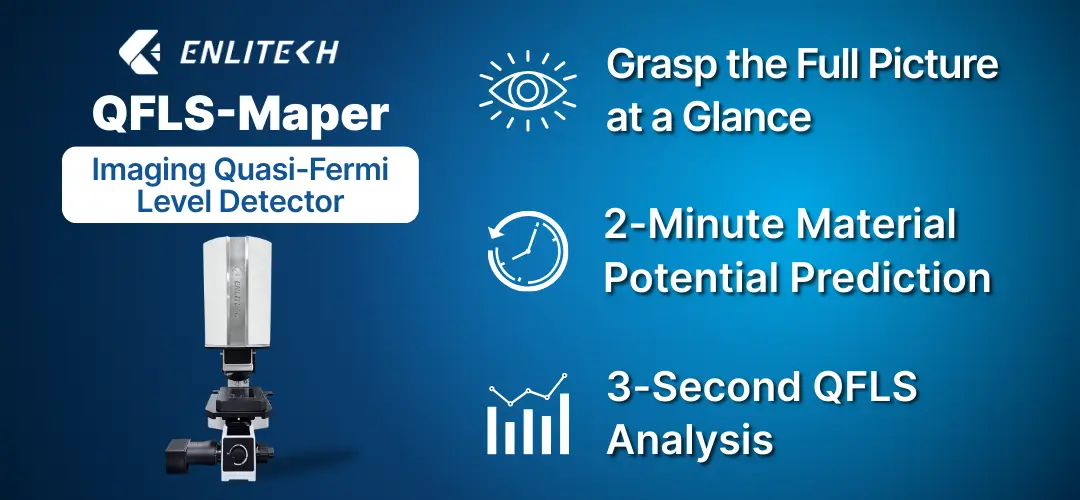
Quasi-Fermi level splitting (QFLS) serves as the key indicator parameter determining the open-circuit voltage limit of solar cells. The team employed QFLS mapping technology to observe the specific impact of C60 deposition on interfacial potential before and after modification. Data from Figure 3d–f reveal that when C60 was deposited on unmodified perovskite/PDAI2 surfaces, the average QFLS decreased from 1.16 eV to 1.08 eV, indicating that direct C60 contact induced significant non-radiative recombination losses.

In contrast, after introducing the 4tBu-CA modification layer, the structure maintained a high QFLS value of 1.16 eV even after C60 deposition, with uniform spatial distribution (see Figure 3f and Figure S12). This confirms that 4tBu-CA performed dual functions as both a physical and chemical barrier, mitigating evaporation-induced interfacial damage and optimizing field-effect passivation. The maintained QFLS value directly translated to improved device voltage, with non-radiative voltage loss (Vnon-rad loss) of only 68 mV, representing one of the lowest levels reported in the literature.

Carrier Dynamics Analysis
Regarding carrier dynamics, transient photovoltage (TPV) measurements in Figure 5a showed that after 4tBu-CA modification, carrier recombination lifetime extended from 14.67 µs to 27.76 µs. Transient photocurrent (TPC) in Figure 5b demonstrated that carrier extraction time shortened to 1.17 µs. These data corroborate that optimized interfacial energy level alignment accelerates electron transfer while effectively suppressing defect-mediated recombination.

Voltage Loss Analysis Using Electroluminescence
For voltage loss analysis, the Enlitech REPS-VOC system was utilized to measure external electroluminescence quantum efficiency (EQEEL).

Figure 5c shows that 4tBu-CA modified devices achieved an EQEEL of 7.15%, significantly higher than the 4.46% of control devices, corresponding to extremely low non-radiative recombination losses and validating the interface passivation quality.

Defect Density Characterization via Urbach Energy
For thin film defect density analysis, the team employed the Enlitech PECT-600 system to measure high-sensitivity EQE curves and fit Urbach energy (Eu).

Results in Figure 5d show that treated perovskite films exhibit the lowest and most concentrated Eu values, representing a substantial reduction in electronic state localization.

External Quantum Efficiency (EQE) Spectral Measurements
Through the Enlitech QE-R3011 system, external quantum efficiency (EQE) spectra were obtained (Figure 4c), with integrated current density of 26.00 mA/cm2, consistent with steady-state measurements and ensuring data accuracy.


Photovoltaic Performance Metrics
The 4tBu-CA modification strategy delivered substantial performance improvements across multiple metrics:
- Small-area device efficiency: Power conversion efficiency increased from 25.41% to 26.68% (Fig. 4b)
- Large-area module performance: 12.96 cm2 modules achieved 23.07% efficiency, demonstrating excellent scalability (Fig. 4h)
- Open-circuit voltage enhancement: VOC improvements directly correlated with maintained QFLS values
- Non-radiative voltage loss: Achieved only 68 mV, among the lowest reported values
Operational Stability Assessment
Stability testing revealed that devices maintained 80% of their initial efficiency after 1100 hours of continuous operation at maximum power point (MPP), demonstrating excellent operational stability (Fig. 5h).

Conclusion
This research establishes a universal strategy for optimizing perovskite/C60 interfaces through supramolecular cavity confinement effects. The introduction of 4tBu-CA achieves ordered C60 assembly while enhancing QFLS through strengthened field-effect passivation. The multi-functional mechanism operates through:
- Structural optimization: The 7.5 Å cavity structure enables host-guest directed assembly with C60, promoting uniform deposition and preventing aggregation-induced transport barriers.
- Chemical passivation: Lower-rim hydroxyl groups chelate uncoordinated Pb2+ ions, eliminating surface defect states that would otherwise serve as non-radiative recombination centers.
- Synergistic coupling: Interaction with PDAI2 molecules further enhances passivation quality and interface stability.
- Physical protection: The modification layer serves as a barrier during C60 evaporation, preventing process-induced damage to the underlying interface.
Ultimately, small-area devices achieved 26.68% power conversion efficiency, while large-area modules (12.96 cm2) reached 23.07%. Stability testing demonstrated that devices retained 80% of initial efficiency after 1100 hours of continuous MPP operation, showcasing excellent operational stability and providing a clear interfacial design direction for developing efficient and scalable perovskite photovoltaic technology.
Original Publication Information
Article Title: Supramolecular Cavity Confinement Inducing Ordered C60 Assembly and Suppressed Interfacial Non-Radiative Recombination for Efficient and Scalable Perovskite Solar Cells
Journal: Advanced Functional Materials
Publication Date: December 30, 2025
DOI: https://doi.org/10.1002/adfm.202530794


