The Challenge of Long-Term Stability Testing in Solar Cell Research
In solar cell research and development, particularly for emerging perovskite and tandem solar cells, long-term aging tests and stability studies are critically important. These tests often require compliance with ISOS protocols and involve extended periods of simulated light exposure. However, if the solar simulator exhibits insufficient stability in light intensity or spectral output during experiments, research teams face difficulty determining whether material degradation originates from the device itself or from light source instability. This significantly impacts data reproducibility and credibility.
For perovskite solar cells and tandem devices, the metastable behavior and hysteresis effects present additional challenges. Researchers need reliable testing equipment that can maintain consistent conditions throughout experiments lasting hundreds or even thousands of hours. Traditional light sources often suffer from spectral drift and require frequent recalibration, interrupting critical long-duration tests and introducing uncertainty into experimental results.
SS-LED220: Advanced LED Technology for Superior Stability

Enlitech’s SS-LED220 solar simulator is specifically designed to address these core challenges. It achieves A++ grade temporal instability performance with values below 0.5%, meaning the light source maintains highly stable intensity and spectral output over extended periods. The SS-LED220’s A++ grade spectral match performance ensures that during aging tests lasting hundreds or even thousands of hours, researchers no longer need to worry about light source drift affecting experimental data.
The fundamental advantage lies in LED’s electroluminescent principle as a solid-state light source. Unlike traditional light sources, LEDs do not alter output wavelength as they age. Operating under precisely controlled voltage, current, and temperature conditions, LED sources avoid the spectral drift issues inherent to conventional lamps. This characteristic ensures your data remains authentic and reliable throughout extended testing periods.
Moreover, the SS-LED220 utilizes LED light sources with an average lifespan exceeding 10,000 hours—significantly longer than traditional lamp lifetimes. This enables continuous long-cycle testing without frequent light source replacement or recalibration, dramatically reducing experimental interruption risks and subsequent maintenance costs. For stability testing compliant with ISOS protocols, the ability to confidently conduct continuous tests exceeding 1000 hours is particularly crucial.
Programmable Intensity Control for Diverse Testing Protocols
Aging tests frequently require simulation of various irradiance conditions, including constant illumination, accelerated aging under high intensity, or cycling illumination profiles. The SS-LED220 features programmable light intensity variation capabilities. It controls light intensity output from 0% to 100% without altering the spectrum. Through specialized intensity adjustment design, it generates 100 intensity variations with minimum precision of 1%, achieving continuous adjustment without individually loading parameter files.
This flexibility enables you to implement stability assessments under constant illumination or employ high-intensity accelerated aging to rapidly observe material degradation mechanisms. You can also simulate day-night cycles or dynamic stress testing, providing exceptional versatility and diversity for your research applications.
Optimized Spectral Performance for Emerging PV Technologies
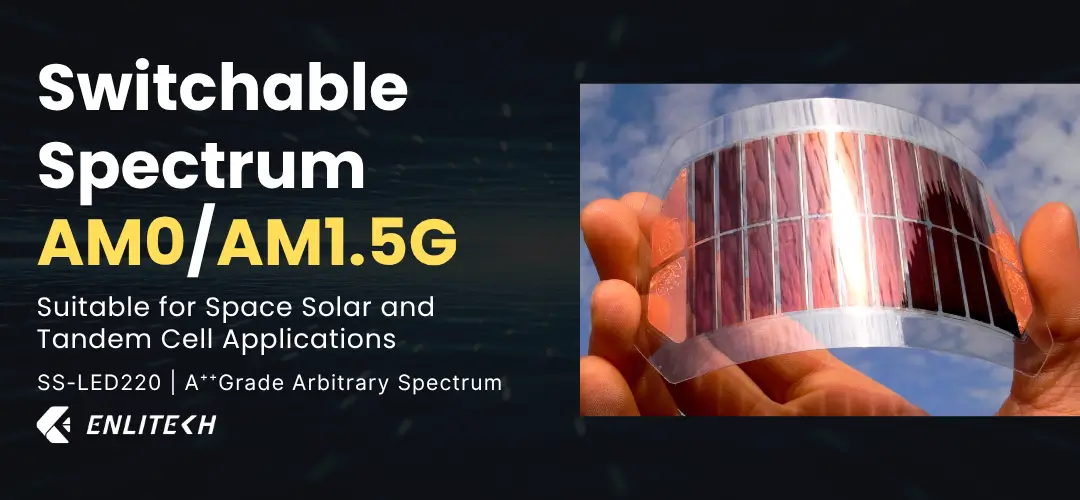
For emerging solar cell materials such as perovskites, we recognize their potential sensitivity to infrared heating. The SS-LED220’s LED light source provides clean and controllable spectrum output. It achieves AM1.5G A++ grade spectral match with mismatch below 6.25%, effectively avoiding unnecessary infrared overheating effects. This reduces extraneous spectral interference with samples, enabling research teams to obtain purer photo-aging data.
Since LED spectra are assembled by stitching multiple LED spectral segments, their precision is adjustable. The SS-LED220 also supports customizable spectrum functionality, allowing precise spectral tailoring—critically important for investigating different wavelength effects on individual sublayers in tandem cells. It complies with international standards including IEC 60904-9.
Environmental Integration and Compact Design
ISOS standard aging tests often require integration with temperature/humidity control chambers to simulate real-world environmental conditions. The SS-LED220’s LED architecture facilitates easier integration with environmental chambers or gloveboxes, with corresponding temperature and humidity control modules available. Therefore, you can more smoothly execute aging tests under ISOS standards.
Its compact lamp housing design, measuring 326mm(L) × 326mm(W) × 830mm(H), is especially suitable for integration in space-limited laboratory environments. This compact footprint does not compromise performance, making it ideal for researchers working within constrained facility layouts.
Advanced Software Features for Perovskite Characterization
Perovskite cells commonly exhibit metastable behavior or hysteresis effects. The SS-LED220’s IVS-KA6000 software supports light soaking measurement functionality and time-sequence programming control. You can first perform pre-light-soaking treatment, typically requiring 2 to 10 minutes to allow devices to reach steady-state conditions, followed by approximately one minute of slow-speed IV curve measurement.
This approach effectively overcomes hysteresis effects, ensuring acquisition of the most authentic and stable output performance data for tandem cells. Our software can also output high-density database formats readable by Python, facilitating in-depth data analysis. Additionally, the KA Viewer software provides analysis functions including ideality factor (n) and tandem calculator, assisting you in more thoroughly analyzing tandem cell characteristics.
Large-Area Uniformity for Multi-Sample Testing
The SS-LED220 simulator provides >220 mm × 220 mm broad illumination area with A grade (<2%) spatial non-uniformity of irradiance. This ensures that when testing larger-sized samples or multiple PVK/Si tandem specimens, every location receives consistent illumination, enhancing experimental result reliability.
This uniformity is particularly valuable for screening multiple devices simultaneously or characterizing large-area modules, improving research throughput while maintaining data quality.
Comprehensive Solution for Long-Term Stability Research
The SS-LED220 solar simulator significantly enhances the efficiency and data credibility of your solar cell long-term stability research through its light output stability, long light source lifetime, programmable intensity control, spectral precision, integration with environmental control systems, and testing features specifically designed for perovskite and tandem cells. This resolves many pain points you may encounter in extended simulated light exposure testing.
We cordially invite you to contact us to learn more about how the SS-LED220 simulator can bring breakthrough advancements to your solar cell long-term stability research.